-
© Universität Bielefeld

Research: Magnetic devices and magnetization dynamics
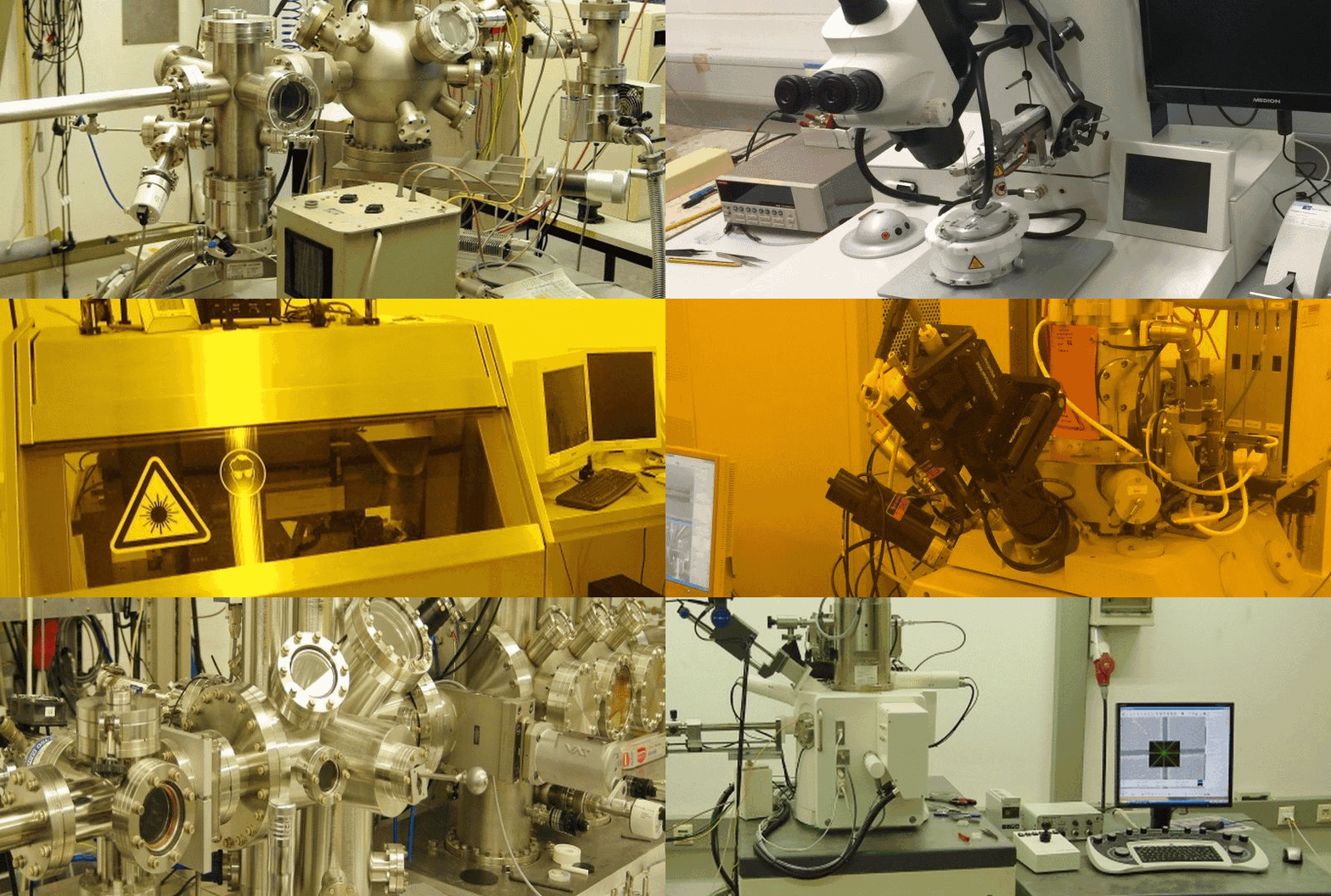 Storage as well as sensing devices of modern micro- nanoelectronics are based on integrated semiconductor technology. Most of the resulting devices have
disadvantage such as being volatile or non flexible after production. In, e.g., data storage magnetic hard disk drives
store data permanently, but are much slower than their RAM counterparts. Here, the Spin Transfer Torque Magnetic Random Access Memory (STT-MRAM) is a promising
perspective to combine the benefits of fast access/writing speeds, non-volatility and
field programmable logic gate arrays (FPGA). Within this context, we investigate spin-dependent
transistor devices or read heads with a current perpendicular to the plane based on the magnetic tunnel junction.
Storage as well as sensing devices of modern micro- nanoelectronics are based on integrated semiconductor technology. Most of the resulting devices have
disadvantage such as being volatile or non flexible after production. In, e.g., data storage magnetic hard disk drives
store data permanently, but are much slower than their RAM counterparts. Here, the Spin Transfer Torque Magnetic Random Access Memory (STT-MRAM) is a promising
perspective to combine the benefits of fast access/writing speeds, non-volatility and
field programmable logic gate arrays (FPGA). Within this context, we investigate spin-dependent
transistor devices or read heads with a current perpendicular to the plane based on the magnetic tunnel junction.
Our research is also targeted towards new magnetocaloric effects in these nanostructured devices. A spin dependence of the thermoelectric effects has been recently discovered and the group is active in exploring the Spin Seebeck effect and the Magneto Seebeck effect
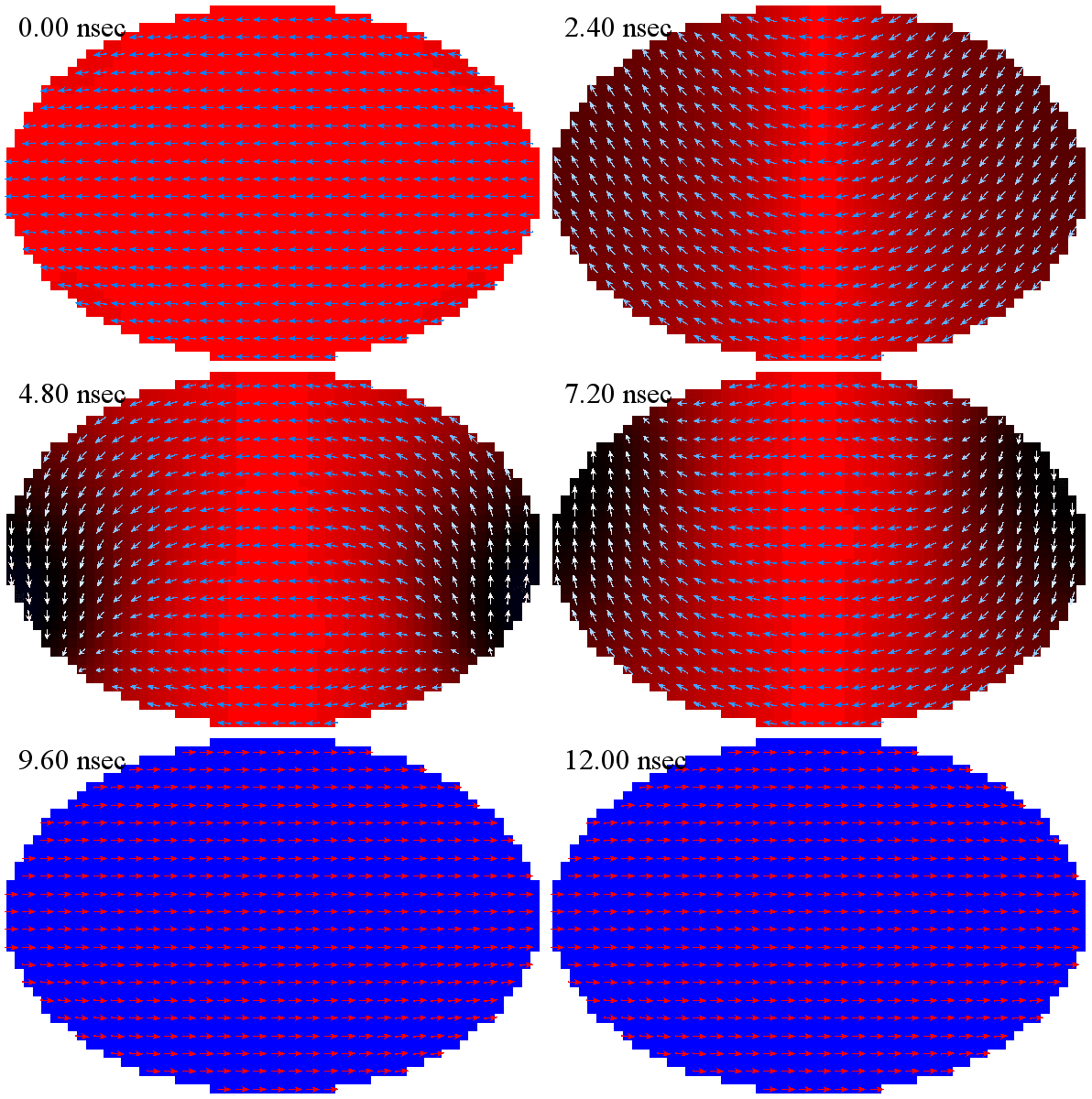
To get fast writing times in these magnetic devices, the magnetization dynamics are very important. We additionally study the dynamics of magnetic nanostructures and magnetic tunnel junctions in terms of spin wave excitation and X-ray circular dicroism in collaboration with research groups in Münster, Braunschweig, Kaiserslautern, Stuttgart and Berkeley.
The so called spin torque switching is
investigated as well to further lower the size and enhance the performance of integrated devices.
Finally, electron-, scanning- and other microscope and high end transport measurement techniques are used to investigate new fields
of research, such as superparamagnetic magnetic tunnel junctions and their use in noisy neural networks for future computing.
Bachelor- and Masterthesis
We always have interesting topics for Bachelor- and Master-Theses within our research fields. Because science is moving on every day, please contact me directly via email (reiss@physik.uni-bielefeld.de) to ask for the latest opportunities for bachelor's and master's theses.Here, you can find the last presentation of the group's topics.
PhD and PostDoc positions
All open positions can be found here.
Vita
 Prof. Dr. Günter Reiss holds a chair for Thin Films and Physics of Nanostructures at Bielefeld University.
 The main activities comprise research on ultrathin magnetic film systems, including investigations on new materials and engineering of band structures and interfaces. Nanopatterning of devices is a central technological know-how of the group and serves both for exploring basic physical properties of new phenomena such as spin dependent tunneling as well as for prototyping devices for sensor- and datastorage technologies.
My publication list can be found here. For further information please go to my ResearcherID page or Google Scholar or send an email (mail to Günter Reiss).
Collaborative units
The research of the group is frequently done in collaborations with other scientists. At present, the group is cooperates within the following research centers:
Center for Spinelectronic Materials and Devices
 Within the CSMD, we prepare and characterizes thin film devices with and for
partners interested in spinelectronics, spincaloritronics and applications. Current research fields are magnetic tunnel junctions, that can be
applied for sensing and data storage. In addition, superparamagnetic tunnel junctions promise applications as probabílistic bits in noisy
neural networks. Sensoric systems for biotechnology that
use the planar Hall effect to achieve ultimate sensitivity within microfluidic environments have been developed within the EU H2020 project
MADIA.
Within the CSMD, we prepare and characterizes thin film devices with and for
partners interested in spinelectronics, spincaloritronics and applications. Current research fields are magnetic tunnel junctions, that can be
applied for sensing and data storage. In addition, superparamagnetic tunnel junctions promise applications as probabílistic bits in noisy
neural networks. Sensoric systems for biotechnology that
use the planar Hall effect to achieve ultimate sensitivity within microfluidic environments have been developed within the EU H2020 project
MADIA.
ForLab Magnetic Sensors and ForMikro spinGMI-Sensors
 are funded by the BMBF within
the initiative Microelectronics from Germany - Innovation Drivers of Digitalization.
are funded by the BMBF within
the initiative Microelectronics from Germany - Innovation Drivers of Digitalization.
- The Center ForLab MagSens is dedicated to realize new magnetic sensor systems within an exceptional
and stimulating research environment. Our new equipment enables high quality thin film systems designed to enhance the performance of sensing systems.
- The joint project spinGMI aims at realizing magnetic sensors and magnetic energy harvesting devices for autonomous and highly sensitive sensors for applications in science and economy.
CiMT
is funded by the EU (EFRE). The strategic goal of the CiMT is to combine the complementary strengths of the Bielefeld University of Applied Science and Bielefeld University for application-oriented materials research in partnership with technologically leading companies in the region for better products and production processes. Within the CiMT, the group explores protective coatings on metals and plastics.