| |
 |
Single Molecule AFM Force
Spectroscopy - PHYSICS OF MOLECULAR RECOGNITION
Contact: Dr. Volker Walhorn |
| |
|
|
| |
|
The investigation of the physical mechanisms
of specific, structure-related intermolecular binding is quantitatively
investigated by single molecule dynamic force spectroscopy with
AFM and OT. Specific molecular forces, elasticities, kinetic
reaction rate constants (lifetimes) and the energy landscape
of the molecular binding potential is quantitatively measured
on a single molecule level on isolated but functional complexes
and recently on membrane bound cellular receptors of a living
cell. Nowadays, these specific interactions can be investigated
in a quantitative manner at the sensitivity level on single-point
mutated molecular species (nucleic acids, amino acids) allowing
single molecule affinity ranking in a broad affinity range of
10E-4-10E-15 M revealing distinct differences in the binding
properties and mechanisms.
Beside the first important experiments on ligand-receptor and
antigen-antibody model systems, we concentrated over the last
four year on the following projects: |
| |
|
|
| |
|
 |
| |
|
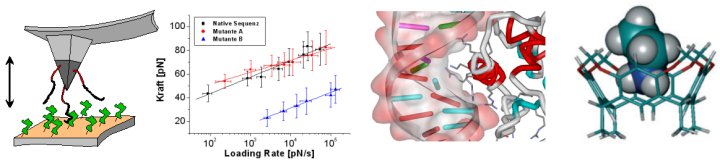
Images: Single molecule force spectroscopy
(2), peptide-DNA interaction supramolecular host-guest-complex |
| |
|
|
| |
Project 1 |
Specific DNA-Protein Interaction (Transcription
Regulation of Galactoglucan-Biosynthesis on Sinorhizobium
meliloti) |
| |
|
Specific binding between a transcriptional
activator ExpG to three wild-type dsDNA sequences of the S.
meliloti gene cluster was investigated with dynamic singe molecule
force spectroscopy and compared to single point mutated gene
sequences, allowing an identification of the involved physical
binding mechanisms as well as the quantification of the physicochemical
parameters (reaction off-rate constants, lifetime, reaction
length) involved.
Currently, the complex regulation cascade of different activating
and repressing regulators (ExpR, PhoR, PhoB, MucR) is under
investigation with a special emphasis on effector-mediated interaction
(Quorum sensing) and cooperative binding phenomena. |
| |
|
Publications: [see section "Publications"] |
| |
|
Collaboration: A. Becker, A. Pühler,
Dept. of Genetics, Bielefeld University |
| |
|
|
| |
Project 2 |
Synthetic Biology and Biomimesis for System
Nanobiology - Artificial Transcription Regulation (Peptide-DNA) |
| |
|
Transcription regulation via specific protein-DNA
binding is often mediated by a helix-turn-helix (HTH) binding
motif, where an alphahelical peptide (recognition helix) binds
into the major groove of dsDNA. Based on the known structures
of recognition helix and DNA sequence of the transcriptional
activator PhoB from E. coli, we synthetically built
wildtype analogue and pointmutated peptide sequences to mimic
and characterize the underlying physical binding mechanisms
(function). We are currently able to tune the affinity by two
orders of magnitudes and aim for the assembly of a complete
artificial HTH binding protein with tailored binding properties
via bioorganic peptide synthesis. |
| |
|
Publications: [see section "Publications"] |
| |
|
Collaboration: N. Sewald, Dept. of Bioorganic
Chemistry, Bielefeld University |
| |
|
|
| |
Project 3 |
Cell Adhesion in Marine Sponges |
| |
|
Specific cell recognition and adhesion in
marine sponges (Microciona prolifera) is mediated via
a new class of circular proteoglycans. The structural and functional
investigation of these aggregation factors which are responsible
for specific cell-cell recognition was realized by AFM and OT,
and allowed identification of the responsible carbohydrate moieties
(g200) and the allocation of a new cell adhesion model in this
fundamental cell adhesion model. |
| |
|
Publications: [see section "Publications"] |
| |
|
Collaboration: X. Fernandez-Busquets, University
of Barcelona & M. Burger, FMI Basel |
| |
|
|
| |
Project 4 |
Molecular Recognition Based on Supramolecular
Chemistry (Calixarene Host-Guest) |
| |
|
In order to design more robust and tailored
artificial molecular affinity for technological applications,
we developed supramolecular cavitands (receptors) which we investigated
successfully against small cationic guest molecules (ligands)
on a single molecule level. Appropriate supramolecular synthesis
schemes will provide new approaches (switchable) for surface
structurization and molecular self-assembly in material science. |
| |
|
Publications: [see section "Publications"] |
| |
|
Collaboration: B. Decker, J. Mattay, Dept.
of Organic Chemsitry, Bielefeld University |
| |
|
|
| |
Project 5 |
Post-Transcriptional Regulation of Gene
Expression (RNA-Protein Interaction) |
| |
|
The protein ATGRP7 from Arabidopsis thaliana
is controlled and regulated by an (inner) circadian clock and
serves as a model for a RNA binding protein which is negatively
autoregulated on a post-trancriptional level. The aim of this
recently started project is to identify the physical binding
mechanisms, to measure the molecular reaction properties, and
to map the time-dependent protein distribution and dynamics
within the cell. |
| |
|
Publications: [see section "Publications"] |
| |
|
Collaboration: D. Staiger, Dept. of Molecular
Cell Physiology, Bielefeld University |
| |
|
|
| |
|
other ongoing projects [...] |
| |
|
|
| |
|
We acknowledge funding from DFG within
SFB 613 (Germany) |